Inside Google Ads AI Max: The 2026 Master Playbook for Eliminating PMax Cannibalization, Profit-Driven Smart Bidding (POAS), and AI Overviews Multi-Query Auctions

Executive Briefing: The Autonomous Search Auction
In 2026, Google Ads has officially decoupled ad serving from strict keyword matching. With the enterprise rollout of AI Max for Search, native ad injection inside AI Overviews & Conversational AI Mode, and universal broad match ingestion, the legacy playbook of bidding on exact-match keyword silos is obsolete. Advertisers relying on raw Target ROAS (tROAS) are flying blind as Performance Max (PMax) cannibalizes organic brand equity. To maintain enterprise margins, growth teams must pivot to Semantic Intent Clustering, Brand Exclusion Firewalls, and First-Party Profit-on-Ad-Spend (POAS) Bidding.
For over two decades, digital marketing teams treated Google Search as a deterministic, keyword-indexed catalog. If an agency built single-keyword ad groups (SKAGs) with tight match types, negative keyword hygiene, and manual CPC pacing, success was virtually guaranteed.
That deterministic paradigm is now dead.
Over the past twelve months, Google deployed the largest structural overhaul to search advertising in its history: AI Max for Search has absorbed Automatically Created Assets (ACA) and campaign broad match; AI Overviews now process more than 25% of commercial queries with real-time multi-query conversational intent; and Dynamic Search Ads (DSAs) are on a strict sunset path toward early 2027.
Beneath the glossy veneer of Google's "automated simplicity," however, lies a lethal trap for CMOs and performance marketing heads: Performance Max brand cannibalization and margin erosion. When algorithms optimize for gross revenue rather than contribution margin, your ad spend migrates toward existing customers and zero-margin commoditized SKUs.
This architectural teardown breaks down the engineering underpinnings of Google Ads AI in 2026 and provides the battle-tested, hermetically sealed framework required to scale profitably.
1. The 2026 Shift: From Keyword Indexing to Vector Semantic Multi-Query Auctions
To understand how ads appear in 2026, you must understand how Google's auction ranking engine interacts with multimodal LLMs (Gemini). In traditional search, a user entered a discrete query string (e.g., "enterprise crm software pricing"). The ad engine performed a lexical lookup against an advertiser's exact, phrase, or broad match tokens, checked the Quality Score, and determined Ad Rank via:
In 2026, user searches have fundamentally mutated. With Google Lens, voice multimodal inputs, and conversational AI Overviews, over 30% of search journeys are conversational compound queries spanning 20+ words (e.g., "Compare cloud ERP platforms for mid-sized manufacturers in Dubai that support ZATCA Phase 2 e-invoicing and have native Shopify integrations under $15k/yr").
No keyword list on earth can predict or match that prompt. Instead, Google's Multi-Query Semantic Retrieval Pipeline runs the prompt through an internal Gemini encoder, decomposes the compound query into 4-6 latent entity sub-vectors, and matches ads dynamically:
Text, Voice, or Lens prompt with complex multi-intent parameters.
Synthesizes: (A) Commercial Intent • (B) Feature Constraints • (C) Geo/Compliance Context • (D) Price Sensitivity.
Contextual product carousel embedded in conversational AI answer.
Dynamic headline synthesis assembled via First-Party Landing Page Vectors.
Evaluates advertiser margin score, user propensity, and landing page latency before placing bid.
2. Deconstructing "AI Max for Search": The New Engine
Google's newly unveiled AI Max for Search represents the official absorption of traditional broad match, Automatically Created Assets (ACA), and keywordless targeting into a single autonomous tier.
Under AI Max, Google does not require you to predict keywords. It crawls your entire landing page index, product feed, and domain structure, building a real-time semantic index of your brand's offerings. When a search query aligns with your entity graph, AI Max:
- Dynamically Synthesizes Ad Copy: Generates custom headlines and descriptions in under 12 milliseconds specifically addressing the user's explicit question.
- Routes to the Deepest Final URL: Bypasses generic category pages to land the user on the exact product variant or solution page solving their query.
- Auto-Injects Regulatory Disclaimers: Uses AI Briefs to enforce mandatory corporate legal disclosures, pricing terms, or compliance warnings even when headlines are generated algorithmically.
Advertisers who attempt to restrict AI Max with 5,000 legacy exact-match keywords choke the algorithm's retrieval surface. Conversely, running AI Max without rigorous negative brand lists and URL exclusion filters causes the model to bid on irrelevant informational queries, burning 30-40% of campaign capital on zero-conversion curiosity traffic.
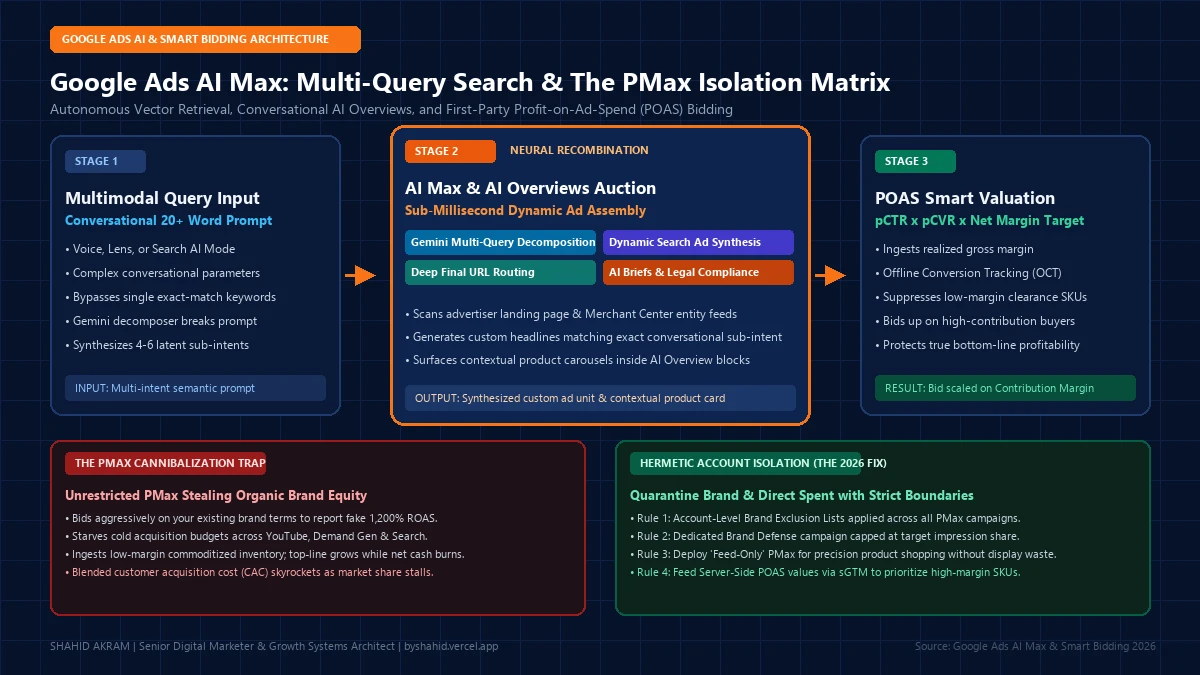
Figure: Google Ads AI Max Multi-Query Retrieval, AI Overviews Auction, and PMax Brand Isolation Matrix.
3. The Performance Max (PMax) Cannibalization Crisis
The most severe operational issue facing enterprise media buyers today is PMax Brand Cannibalization.
Performance Max is designed to optimize for conversion count or conversion value across all of Google's inventory: Search, Shopping, YouTube, Discover, Gmail, and Display. To an unconstrained machine learning model, the easiest way to generate high "conversion value" at a stellar "ROAS" is to bid aggressively on users who are already searching for your brand name.
The Anatomy of Algorithmic Cannibalization
When a brand deploys a standard PMax campaign without architectural boundaries, the following cascade occurs:
- Brand Hijacking: A customer types your exact company name into Google Search. PMax enters the internal auction against your dedicated Brand Search campaign. Because PMax has auction priority and dynamic asset generation, it wins the impression.
- The ROAS Illusion: PMax reports an astounding 1,200% ROAS. Leadership assumes the algorithm has discovered high-intent cold customers. In reality, 75% of those conversions were existing customers who would have clicked your organic listing for free.
- Cold Acquisition Starvation: The algorithm reallocates 60-80% of your daily budget away from cold YouTube, Demand Gen, and non-branded Search into branded traffic. Your top-of-funnel pipeline dries up, your customer acquisition cost (CAC) skyrockets, and net blended revenue plateaus.
| Campaign Type | Primary Role in 2026 | Targeting Vector | Cannibalization Risk |
|---|---|---|---|
| Performance Max (Unrestricted) | Full-funnel auto-scaling | Asset groups & audience signals | EXTREME (Eats Brand & Direct) |
| Performance Max (Isolated / Feed-Only) | Pure product discovery & shopping | Merchant Center feed attributes | LOW (When Brand Excluded) |
| Dedicated Brand Search (Manual / tImp) | Brand defense & SERP dominance | Exact match brand tokens | CONTROLLED (Fixed cost floor) |
| AI Max for Search (Non-Brand) | High-intent cold capture | Semantic intent & landing page URLs | ZERO (Brand Negatives Enforced) |
4. The Solution: The Hermetically Sealed 2026 Account Architecture
To defeat PMax cannibalization and harness Google Ads AI without losing control, we implement a Four-Tier Hermetic Isolation Model:
The Four Isolation Rules:
Apply an official Brand Exclusion List to every PMax campaign. This forces PMax out of the brand auction entirely, stripping away artificial ROAS inflation and compelling the model to acquire net-new prospecting volume.
House brand keywords in an isolated Search campaign with Target Impression Share (e.g., 95% Absolute Top of Page) or low manual CPCs. Cap its daily budget to prevent runaway brand bidding.
If running e-commerce, build a "Feed-Only" PMax campaign (zero text, zero image, zero video assets). This forces PMax to act as a precision Smart Shopping campaign without bleeding spend into low-quality Display or unvetted YouTube placements.
Activate Google Ads Customer Match and Enhanced Conversions. Set PMax to "Bid higher for new customers" or "Only bid for new customers", guaranteeing that ad dollars are allocated exclusively toward expanding market share.
5. The Margin Revolution: Upgrading from tROAS to POAS (Profit on Ad Spend)
The fatal flaw of modern Smart Bidding is that it optimizes for the numbers you report. If you tell Google's algorithm that an order generated $500 in revenue, it treats that order with the same algorithmic weight regardless of whether your net margin was 45% ($225 profit) or 4% ($20 profit).
Under standard tROAS, the algorithm rapidly discovers that discounted, commoditized products sell faster. It floods budget into your lowest-margin inventory, resulting in record top-line revenue alongside collapsing net bank balances.
The POAS Formulation
Elite growth teams in 2026 bid on POAS (Profit on Ad Spend):
By feeding Net Gross Profit into Google Ads as the primary conversion value via Server-Side Google Tag Manager (sGTM) and Offline Conversion Tracking (OCT), Smart Bidding recalculates its predictive bids. The algorithm actively suppresses high-churn, low-margin products and aggressively bids on high-contribution inventory.
Server-Side Measurement Protocol Payload (2026 Standard)
Below is the sanitized server-to-server payload ingested into GA4 / Google Ads OCT to pass realized contribution margin back to the bidding engine:
POST /mp/collect?measurement_id=G-XXXXXXXXXX&api_secret=YOUR_API_SECRET HTTP/1.1
Host: www.google-analytics.com
Content-Type: application/json

{
  "client_id": "984210543.1704201928",
  "events": [
    {
      "name": "purchase",
      "params": {
        "transaction_id": "ORD_2026_98124",
        "currency": "USD",
        "value": 184.50,            // Realized Net Profit (POAS Target)
        "gross_revenue": 450.00,    // Top-Line GMV
        "cogs": 210.00,             // Cost of Goods Sold
        "shipping_fulfillment": 35.50,
        "payment_gateway_fee": 20.00,
        "customer_type": "new_acquisition",
        "items": [
          {
            "item_id": "SKU_PREMIUM_ENTERPRISE",
            "item_name": "Autonomous Workflow Suite",
            "price": 450.00,
            "quantity": 1,
            "margin_tier": "tier_1_high_margin"
          }
        ]
      }
    }
  ]
}
6. Executive Takeaways & 7-Day Implementation Checklist
Transitioning your Google Ads infrastructure to withstand the 2026 autonomous AI auction requires immediate operational restructuring. Use this 7-day checklist:
Shahid Akram is a Senior Digital Marketing & Paid Media Specialist specializing in high-converting ad infrastructure, Meta Ads scaling, Google Ads AI architecture, and GCC/UAE performance funnels. He consults for high-growth enterprises and founders looking to eliminate ad waste and engineer profitable customer acquisition engines.


Comments
Post a Comment