Inside Meta Andromeda: The AI Retrieval Engine Rewriting Facebook & Instagram Ads in 2026
The Invisible Engine Behind Modern Meta Ad Delivery
Over the past 18 months, media buyers worldwide have reported sudden shifts in Facebook and Instagram ad performance: unpredictable CPA spikes, lookalike audience decay, and creative fatigue striking within days. While advertisers debated Advantage+ settings, Meta quietly deployed Project Andromeda—a high-throughput, AI-driven personalized ads retrieval engine that fundamentally rewrites how ad auctions operate.
For over a decade, digital advertisers operated under a simple premise: you define a target audience (interests, behaviors, lookalikes), set a bid, and upload a creative. Meta’s auction engine would calculate who gets impressions based on estimated action rates.
In 2026, that playbook is officially obsolete.
With the full production scaling of Meta Andromeda, Meta moved machine learning from the ranking phase all the way upstream to the retrieval phase. Understanding this architectural shift is the single most critical advantage for performance marketers, growth engineers, and agency founders today.
The Multi-Stage Ad Delivery Funnel: Where Andromeda Lives
Every active ad globally eligible for impression when an Instagram or Facebook user opens their app.
The Gatekeeper: Sifts through tens of millions of candidate ads in sub-milliseconds. Uses Mixture-of-Experts (MoE) and high-dimensional semantic embeddings to shortlist roughly 1,000 highly relevant candidate ads. If your ad does not survive Andromeda, downstream auction ranking never even sees it.
Heavyweight neural networks (GEM / Multi-task ranking) score the shortlisted ~1,000 candidates based on conversion probability, expected advertiser value, and user satisfaction to pick the winning ad.
1. The Engineering Feat: Hardware-Software Co-Design
Why did Meta need Andromeda? Scale. With more than 3.2 billion daily active users and tens of millions of advertisers spinning up hundreds of thousands of AI-generated creative permutations daily, traditional database indexing choked.
Meta’s engineering papers reveal that Andromeda was co-designed directly around custom hardware:
- NVIDIA Grace Hopper & Meta MTIA Silicon: Andromeda leverages high-bandwidth NVLink-C2C memory interconnects between CPU and GPU, eliminating the traditional PCIe transfer bottleneck.
- Fused GPU Kernels: Index matching, candidate scoring, and top-K selection are fused into single-pass GPU execution routines, achieving a staggering throughput of over 1 billion ads processed per second per GPU server.
- Mixture-of-Experts (MoE): Instead of running a monolithic neural network over every candidate, Andromeda dynamically activates specialized subnetworks depending on the content genre (e-commerce, SaaS, lead generation, local services), slashing compute cost while multiplying accuracy.
The Revolutionary Axiom: Creative Is The Targeting
In legacy Meta Ads, the advertiser told Meta who to target via demographic filters. In Andromeda, Meta reads your creative directly. The model ingests raw video frames, audio speech cadences, OCR text overlays, and caption sentiment to build a high-dimensional vector. Andromeda then compares that vector against the user's real-time engagement vector. Your creative itself acts as the primary demographic filter.
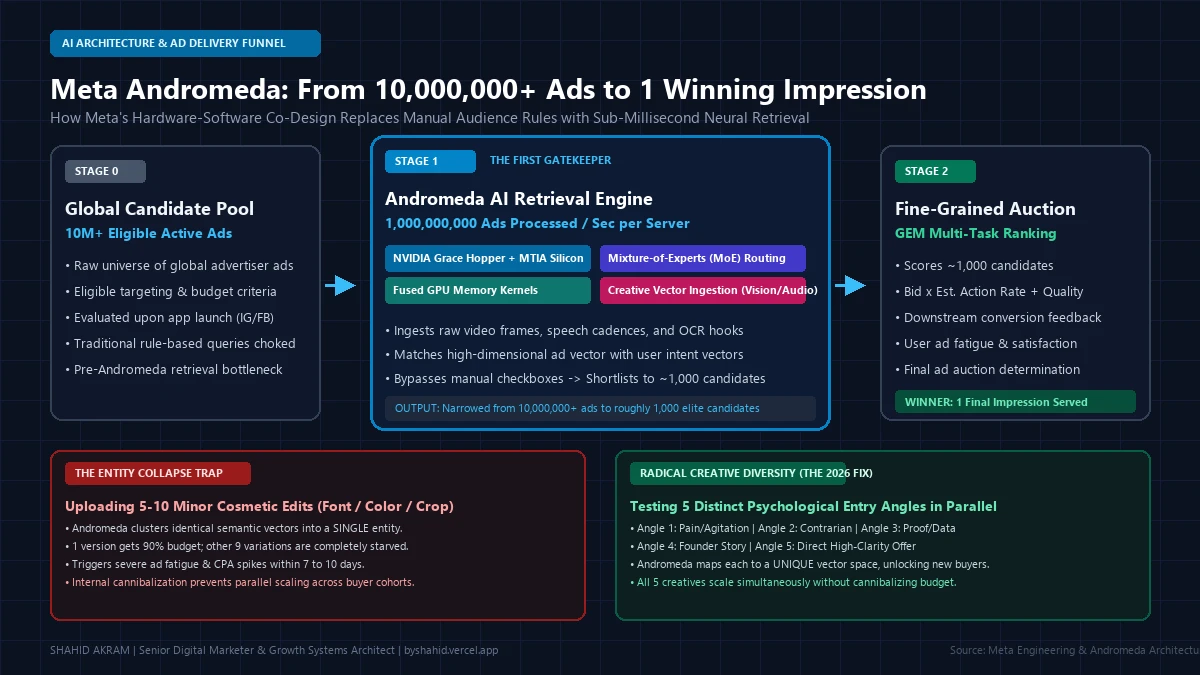
Figure 1: Meta Andromeda's hardware-software co-design (Retrieval vs. Ranking) and Entity Collapse vs. Radical Angle Diversity.
2. The Deadly Agency Trap: "Entity Collapse"
Understanding Andromeda immediately explains why many media buying agencies are struggling in 2026. The classic media buying trick was to create 10 "variations" of a winning ad:
- Change the headline color from yellow to green.
- Swap the opening 1-second text card font.
- Use a slightly different product image crop.
Under Andromeda, this creates the fatal phenomenon known as Entity Collapse.
Because Andromeda uses semantic vector clustering, two ads that communicate the same underlying pitch with cosmetic differences are recognized as the same mathematical entity.
Instead of testing two distinct audiences, Andromeda collapses the two ads together. One version wins 95% of the spend, the other 9 version get starved with zero impressions, and the primary creative burns out within 7 to 10 days because the algorithm refuses to serve cosmetic duplicates to fresh audience pockets.
| Dimension | Legacy Meta Ad Engine (Pre-Andromeda) | Andromeda Engine (2026 Production) |
|---|---|---|
| Primary Targeting Signal | Manual Audiences, Lookalikes, Interests | Creative Vectors, Audio Hooks, Copy Context |
| Account Structure | Micro-segmented ad sets (10-20 interest buckets) | Consolidated Broad Ad Sets (Advantage+ Shopping / Leads) |
| Creative Variation | Cosmetic tweaks (button colors, micro-crops) | Radical Angle Diversity (5 distinct psychological hooks) |
| Data Feedback Loop | Browser Pixel Cookies (Struggling post-iOS14) | Server-Side Conversions API (CAPI) + First-Party Offline Signals |
3. The 2026 Strategic Playbook: How to Win with Andromeda
Advertisers who adapt to Andromeda’s retrieval architecture are seeing historic efficiency, while those holding onto 2021 tactics face rising costs. Here are the 4 non-negotiable rules for your ad campaigns:
Rule 1: Build for "Radical Creative Diversity"
Stop testing 10 minor edits of one video. Instead, produce 4 to 5 fundamentally distinct psychological concepts that target different customer personas:
- Concept A (Pain-Agitation): Lead with the sharpest customer frustration.
- Concept B (Contrarian / Us vs. Them): Challenge conventional industry wisdom.
- Concept C (Data / Social Proof): Raw case studies, metrics, and visual demonstrations.
- Concept D (Founder / Behind the Scenes): Transparent, narrative-driven storytelling.
- Concept E (Direct Offer / Urgency): High-clarity value proposition and immediate call-to-action.
Result: Andromeda assigns each concept to a separate vector space, allowing all 5 creatives to scale in parallel without entity collapse.
Rule 2: Consolidate Budgets into Broad Ad Sets
Micro-segmenting ad sets starves Andromeda's Mixture-of-Experts routing. Consolidate your spend into broad targeting ad sets (Advantage+ campaigns) and let Andromeda dynamically route candidate creatives to the exact micro-cohorts primed to convert.
Rule 3: Feed First-Party Conversions via CAPI
Andromeda’s retrieval weights are constantly updated by downstream post-click conversion events. If your Conversions API (CAPI) Event Quality Match score is below 8.0/10, Andromeda cannot calculate customer lifetime value or high-intent purchase signals, relegating your ads to lower-tier candidate pools.
The Bottom Line
Meta Andromeda has transformed media buying from a spreadsheet exercise into a creative engineering discipline. Advertisers who understand how the AI retrieval layer evaluates audio, visual, and semantic hooks will dominate customer acquisition in 2026.
Founder of Zotir Labs • Explore Portfolio & Strategic Audits • WhatsApp: +92 300 4822560
Senior Digital Marketer, Growth Strategist & Systems Architect specializing in high-converting ad infrastructure, Meta Ads scaling, Google Ads AI architecture, and GCC/UAE performance funnels. He consults for high-growth enterprises and founders looking to eliminate ad waste and engineer profitable customer acquisition engines. Explore production code, open-source models, and developer tools on GitHub.


Comments
Post a Comment